
by Anne MacLennan
A Joint Statement from food and security experts calls on the Government to re-evaluate its assertion that ‘the UK has a resilient food system’ and to update the national food strategy in the light of increasing risks to food security. Food priceswere already on track to be 50% higher than in 2021 by the end of this year. Add in the effects of extreme weather, inflation and the Iran war, and Britain is sleepwalking into a food crisis.
Transforming our food system ‘to be based on the principles of health, resilience, justice and sustainability’ is obviously an enormous challenge. The public are encouraged to be ‘energized to be part of the collective solution’. That includes us in Skye and Lochalsh.
In Norway, the Environmental Agency wishes to make changes to domestic food production in order to meet climate commitments, while at the same time, maintaining nutrient adequacy. Not so straightforward as they would like to cut ruminant meat, pork and dairy for the benefit of the climate, while increasing self-sufficiency of plants, protein, energy and fat, but home-grown meat currently contributes importantly to several nutrients. Self-sufficiency of food and all of the essential nutrients is an important part of national resilience, so they don’t want to increase imports to satisfy domestic demand for meat and dairy.
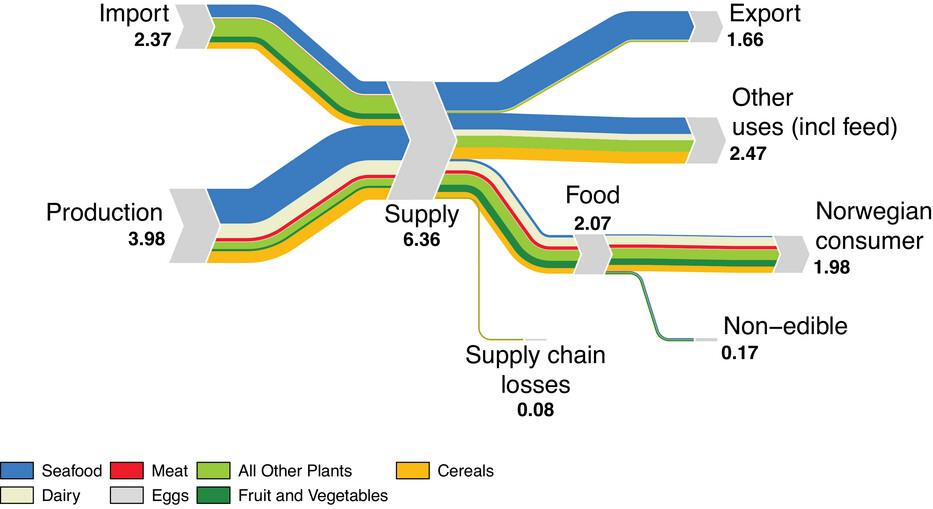
Norway’s current food flows.
To figure out this delicate balancing act, they modelled five scenarios with differing levels of meat reduction and imports, comparing them against the current situation. The resulting diagrams are fascinating to see how food systems work. For example,
reduction of red meat and pork by 30% makes virtually no difference to the food available (F in the figure below).
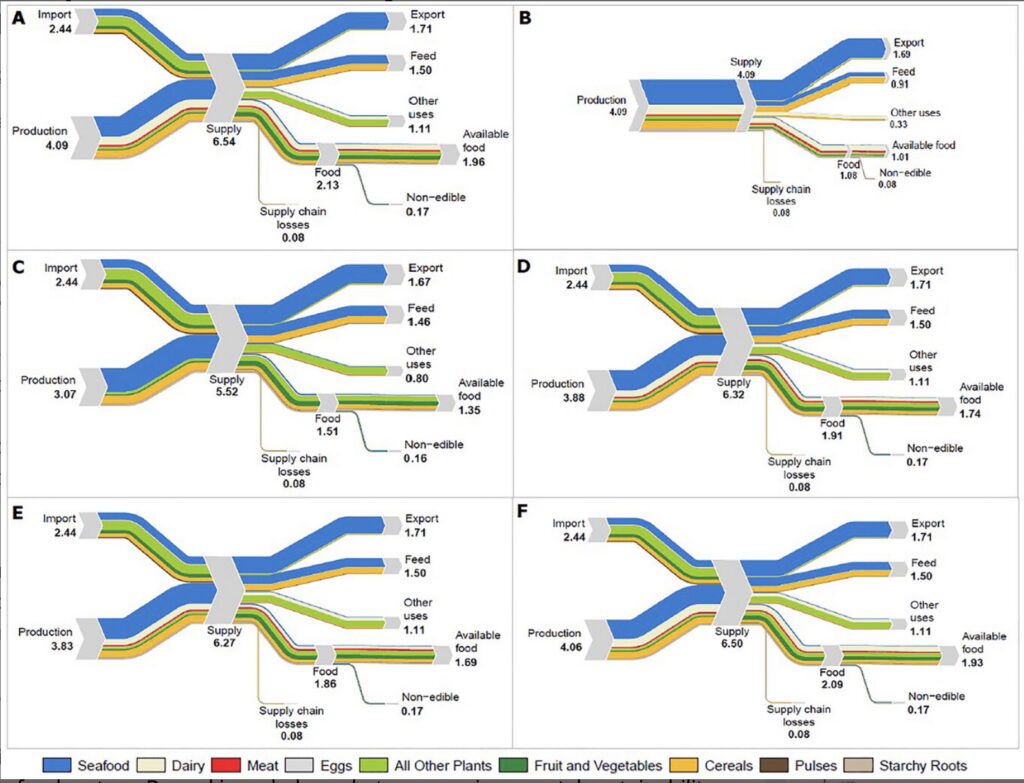
(A) current scenario, (B) no imports, (C) elimination of domestic animal production, (D) reduction of ruminant meat by 30% and dairy by 25%, (E) reduction of ruminant meat by 50% and dairy by 30%, (F) Reduction of red meat and pork by 30%.
What would Scotland’s diagram look like? Most of our grain crops are not used for domestic human consumption. Over half of barley is used for malting and a third as animal feed. Wheat is mainly used as feed and most of the oilseed rape is exported.
Can Scotland feed itself if global supply chains fail? Well, not totally. There’s about enough protein if farmed fish is included (though perhaps not sustainable), but insufficient calories. Scottish farmers are concerned about current conditions including fuel, fertiliser and imported livestock feed costs and availability. Legumes (peas and beans) have important environmental and nutritional benefits. They make up a tiny proportion of crops at the moment, but could reduce the need for imported livestock feed and nitrogen fertilisers, while providing more sustainable protein.
Scotland has to ‘rethink farming, sustainability and supply chains to feed itself resiliently’. The article has interesting commentary on this increasingly recognised threat to our way of life and easy access to food for most. One farmer remembers that ‘People used to say that a population with full bellies are always happy. Empty bellies will produce unrest;’ – concerns echoed by a global security conference earlier this year.