by Anne MacLennan
A flurry of publications in recent weeks highlight the need to build resilience in preparation for interacting multiple hazards such as extreme weather events, economic turmoil and cyber-mischief in our interconnected, but unstable, global community.
Although Britain’s greenhouse gas emissions have reduced 42% since the Climate Change Act (2008), the world continues to emit greenhouse gases at a great rate, bringing widespread impacts now and into the future, and we’re not prepared to cope with these inevitable changes. ‘What governments have been doing on adaptation clearly isn’t working’ according to the Climate Change Committee’s latest report, A Well-Adapted UK.
‘The UK was built for a climate that no longer exists today’ and should be prepared for weather extremes that will be experienced if global warming reaches 2°C above preindustrial levels by 2050 and, alarmingly, 4°C by 2100. The report packs a lot of information and recommendations into 550 pages (!)
They identify three key hazards driving ‘fundamental challenges to the functioning of the UK’: intensifying heat, floods, and drought/wildfire risks.
Heat has been well demonstrated this May, breaking yet more records. Increasingly extreme and frequent heatwaves are considered the greatest climate change health risk in the UK. Last year there were over 3,000 heat-related deaths in England, so the report strongly recommends cooling systems for hospitals and care homes in particular. Annual flood (financial) damage is already estimated at £3.3bn pa, never mind the disruption and distress to communities, health impacts, crop and livestock losses.
Last year’s wildfire round Carrbridge and Dava Moor was the biggest recorded in UK history. Despite the droughts, overall rainfall has actually increased. It’s just that it is more erratic, with heavier dumps and potentially long dry periods between the dumps, so the House of Commons publication on managing drought: Surviving Drought: Reclaim the Rain, recommends demand reduction through efficiency, water re-use and rainwater harvesting. Pity then, that Data Centres are so thirsty.
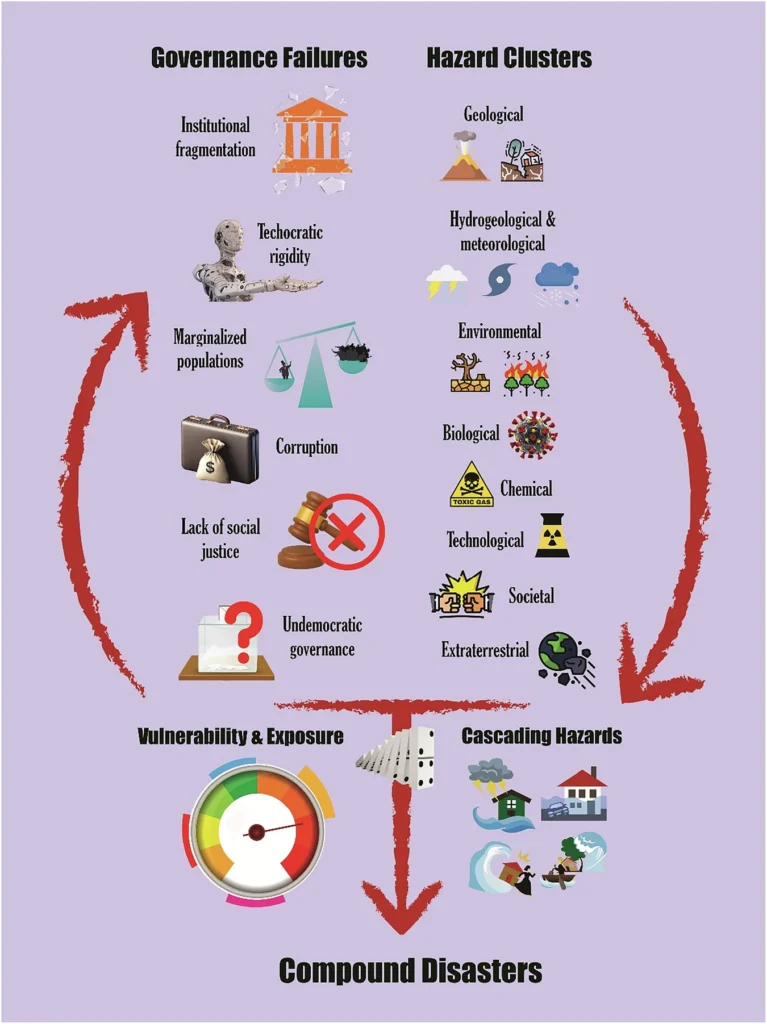
Extreme weather events disrupt daily life and the economy, but multi-hazard events compound the impacts, as when heavy rainfall occurs with severe winds. Cascading hazards are also becoming more frequent. Thus the ‘Beast from the East’ blocked roads, disrupted transport, and supermarket shelves couldn’t be restocked, threatening food insecurity.
Strathclyde University research explored multi-hazard events in rural Scotland. There is a useful overview of extreme weather over the past few years and they heard from people involved in emergency services, business, agriculture, tourism and community organisations about their experiences and perspectives. It is suggested that the UK lacks the assessment methods and data to really understand multi-hazard processes and can therefore underestimate the risks and their cascading impacts on environmental and human systems.
For these informants, risk management can be complicated by financial restraints, outdated infrastructure and societal resistance. Extreme events strain human resources, community resilience, and infrastructure. Some reported poor cross-sectoral coordination and lack of tailored resources for rural areas. High level legislation, frameworks, protocols and guidance don’t always translate into grassroots effective action, so an important take-home message is the value of integrating on-the-ground experience and insights to strengthen Scotland’s overall resilience.
Natural hazards are not necessarily disastrous. Societal and economic outcomes depend on human decisions, governance responses, and social vulnerability. Exposure, inadequate infrastructure, and a lack of preparedness are major factors turning an event into a disaster. The urgent need to improve disaster preparation is reiterated. Systems which enable disasters, whether economic, political, cultural or scientific must be reviewed. This will be costly, but the costs of inaction are far higher.