
 by Shona Cameron
CLIMAVORE is a social enterprise which designs community-led, circular food systems that are ecologically restorative and socially reparative. Established in 2019, in Skye and Raasay, CLIMAVORE collaborates with local residents, schools and restaurants alongside international researchers and activists to share new approaches to sea-farming and food waste.
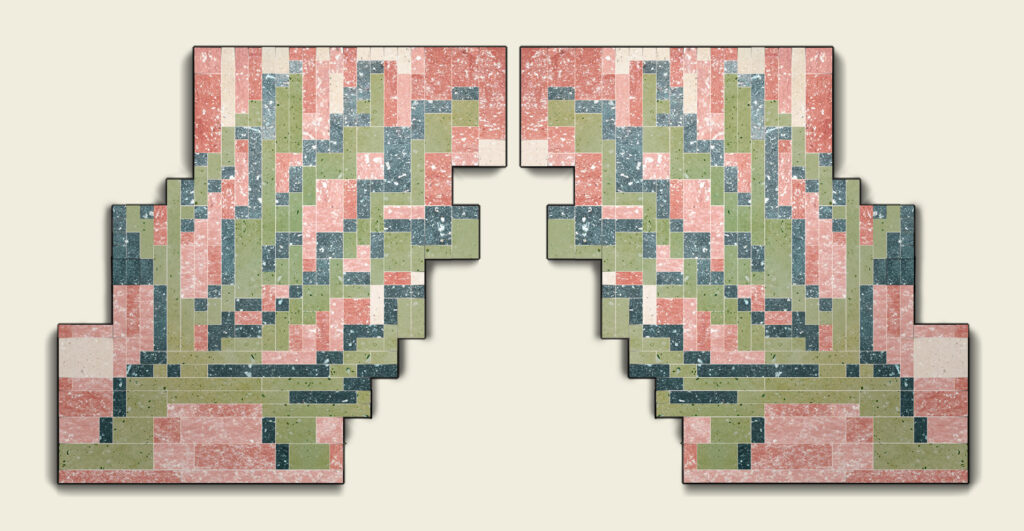
Since 2019, CLIMAVORE has been collecting waste shells from partner restaurants in Skye and Raasay, and reconfiguring them into a new material for a series of artworks: Bivalve Murals. Made out of crushed seashells, they consist of abstract murals reimagining the future of the coast and the tidal commons. Born to support alternative aquacultures, the five unique murals are like the two shells of an oyster or a mussel: each commissioned panel has a mirrored twin. One will enter a public art collection internationally; and one will remain in a community location in Skye and Raasay. Similar to how towns are twinned, we see these murals as umbilical cords feeding and supporting each other, re-establishing the bonds between culture and agriculture.
Oysters, mussels, scallops or clams have been used by coastal communities as a key ingredient for millennia: both as protein in our diet and as a natural building material. Replacing highly polluting conventional cement and other aggregates with discarded seashells has led CLIMAVORE to pioneer a new type of terrazzo-like composite. This not only reduces the amount of waste going to landfill, but it also contributes towards a new economy and ecology.
The material is innovative because it looks to Skye’s historical connection to creating lime and using shells in construction, but transforms it into a 21st-century product. As part of this initiative, we will invest in a new CLIMAVORE workshop to further develop this material, creating training opportunities and jobs, contributing to community wealth building. Bivalve Murals is a call for hopeful action: a transition for coastal communities bringing together the food and construction sector, while imagining new futures for our waters.